Post Mortem: What Happened on Polygon PoS on September 10, 2025
The Polygon PoS finality incident on September 10, 2025, created notable finalization delays of up to 1 hour and lasted around 12 hours. The event centred around a consensus milestone bug, which delayed transaction finality while block production continued.
What Happened
On September 10, 2025, Polygon’s Proof-of-Stake (PoS) network experienced a bug that caused delays of between 15 minutes and up to 1 hour in transaction finality, even as blocks continued to be produced. While most user transactions typically complete within seconds, applications and exchanges which depend on irreversibility and final block confirmation faced disruptions. Validators, RPC providers, and DeFi platforms reported stalled or limited transaction processing, temporarily freezing high-assurance activities until the issue was patched.
The Technical Details
The incident originated from a faulty milestone proposal affecting Polygon’s Bor block producer and Heimdall implementation. This bug prevented certain nodes from advancing and disrupted the finality checkpoints that anchor Polygon’s security to Ethereum. Affected nodes either needed to be restarted or rolled back and resynced to the last finalized block. Five hours after the incident started, Polygon’s engineers rolled out an emergency hard fork, which resolved the bug and restored regular milestone and checkpoint processing. During the incident, exchanges, DeFi protocols, and dApps requiring instantaneous finality were forced to halt or delay operations to avoid possible transaction reversals.
How Metrika Detected the Real Impact
While our uptime monitoring showed the chain remained operational, Metrika captured the incident through at least two other Key Risk Indicators (KRIs):
- Finalization Time: big increase to almost 1 hour
- Block Interval Time: Almost doubled and became much more erratic than usual
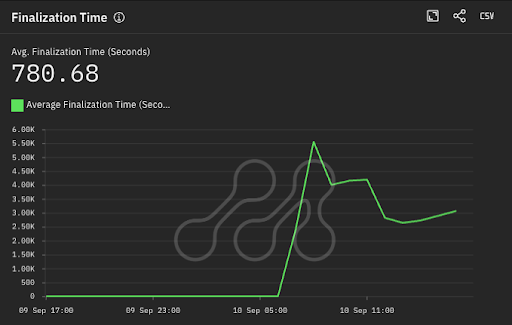
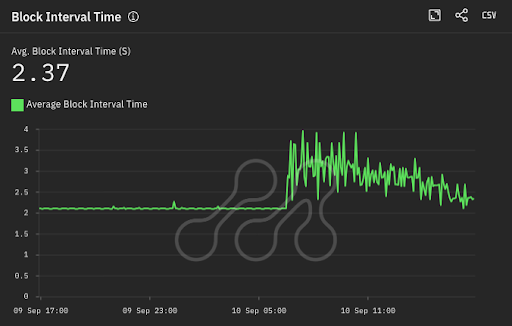
Source: Metrika Platform (Time Zone UTC +2)
Risk Monitoring Lesson for Financial Institutions
For financial institutions, the incident highlights why robust risk monitoring and contingency plans are essential when using any public blockchain. Finality—the assurance that a transaction is irreversible and cannot be reorganized—is critical for safeguarding against risks like double-spending or transaction rollbacks. Delays in finality can impact settlement reliability, liquidity management, and customer trust. Institutions integrating with Polygon or similar networks should ensure real-time monitoring, robust alerting for unusual consensus behavior, and the capacity to pause or delay asset transfers, mints or burns if finalization times deviate from norms.
Additional Context and Past Incidents
Polygon PoS has experienced previous upgrades, such as the Heimdall v2 hard fork on July 10th, 2025 and periodic hard forks to improve network reliability. However, bugs—especially those affecting consensus or node synchronization—have occasionally disrupted service, though generally with quick remediation by the Polygon team. The hard fork executed during this incident is part of ongoing efforts to fortify network finality and resilience, especially as institutions and protocols place increasing demands on the chain’s reliability.
Sources
- CoinDesk: Polygon PoS Sees Transaction Finality Lag, Patch in Progress (Sep 10, 2025)
- The Block: Polygon PoS chain faces delay in reaching consensus finality (Sep 10, 2025)
- The Block: Polygon rolls out hard fork to address finality bug causing transaction delays (Sep 10, 2025)
- CoinTelegraph: Polygon’s ‘most complex’ hard fork goes live Thursday (July 9, 2025)